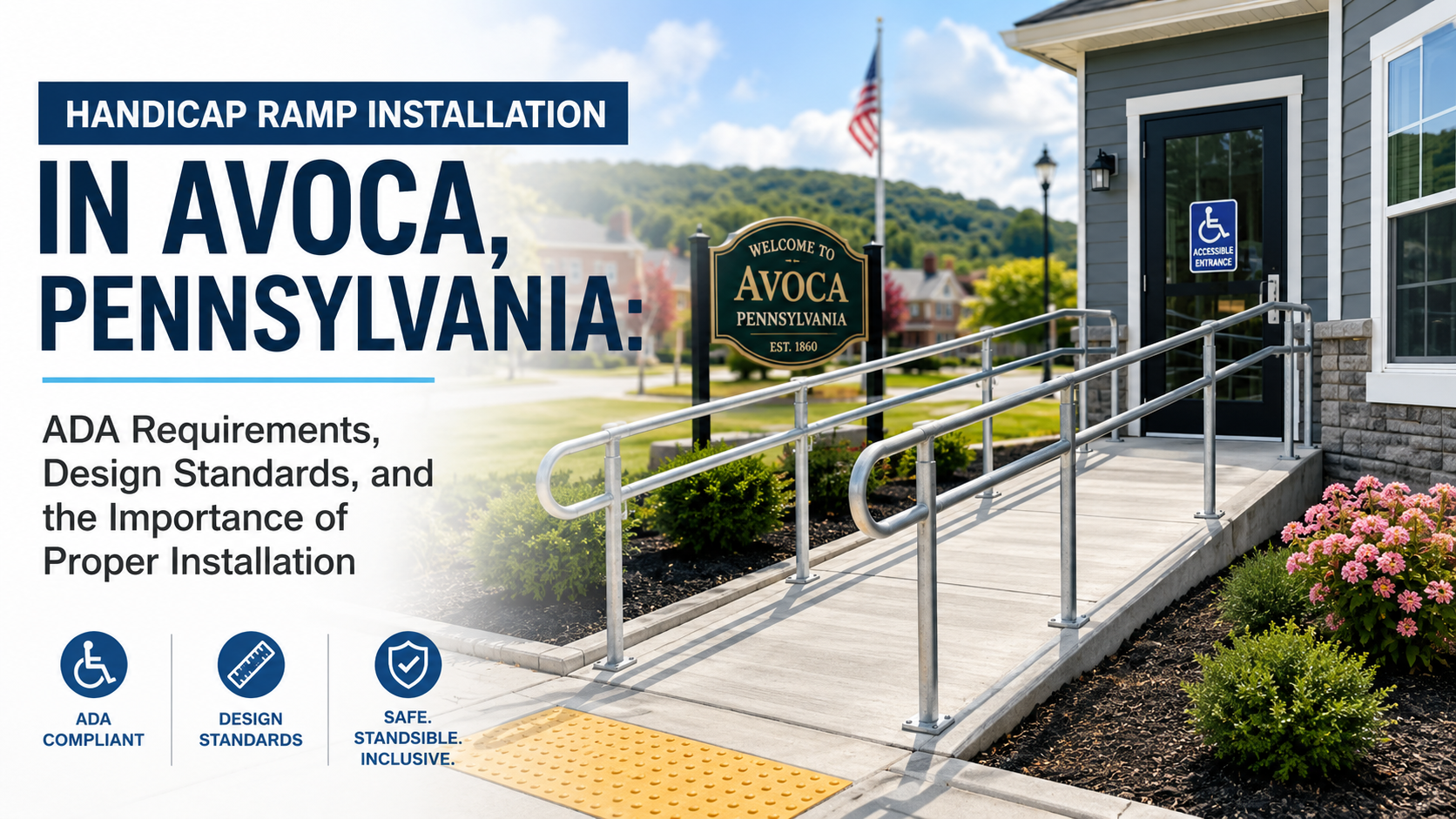
Handicap Ramp Installation Avoca is one of the most regulated and technically specific aspects of concrete and pavement work. In Avoca, Pennsylvania and across Luzerne County, property owners with commercial facilities, institutional buildings, and public spaces are required by federal law to provide accessible routes for individuals with disabilities. The Americans with Disabilities Act (ADA) establishes detailed standards for how ramps must be designed, built, and maintained standards that exist not as bureaucratic requirements, but because the functional safety and independence of people with mobility limitations depend directly on whether those standards are met.
What the ADA Requires for Accessible Ramps
The ADA Accessibility Guidelines (ADAAG) specify the precise dimensions, slopes, surfaces, and features that accessible ramps must meet. These standards apply to any property that provides public accommodations or commercial services including retail businesses, professional offices, restaurants, healthcare facilities, schools, religious organizations, and government facilities. Key requirements include:
- Slope (run-to-rise ratio): The maximum allowable slope for an ADA-compliant ramp is 1:12 meaning one inch of vertical rise for every twelve inches of horizontal run. This translates to an 8.3% slope. Ramps steeper than 1:12 are not ADA-compliant and may not provide safe access for wheelchair users.
- Maximum rise per run: Each individual ramp run can rise no more than 30 inches vertically before a level landing must be provided. For rises greater than 30 inches, the ramp must be divided into multiple runs with intermediate landings.
- Minimum clear width: The clear width between handrails (or between edge protections where handrails are not required) must be at least 36 inches.
- Landings: Level landings must be provided at the top and bottom of every ramp run, and at turns or intersections. Each landing must be at least 60 inches long and at least as wide as the ramp.
- Handrails: Handrails are required on both sides of any ramp with a rise greater than 6 inches. Handrails must be between 34 and 38 inches high, continuous along the run, and graspable with a hand.
- Surface: The ramp surface must be firm, stable, and slip-resistant. Outdoor ramps in Pennsylvania must account for the slip resistance of the surface when wet or icy.
- Edge protection: Edges of ramps and landings that are not bounded by walls or curbs must have edge protection to prevent wheelchair wheels from slipping off.
Curb Ramps: The Most Common Application in Avoca
The most frequently installed type of accessible ramp in commercial and institutional settings in Avoca is the curb ramp a transition built into or through the curb line at crosswalks, parking lot access points, and building entrances. Curb ramps allow wheelchair users, people with walkers, and others with mobility limitations to transition between grade levels (from sidewalk to roadway, or from parking lot to pedestrian walkway) without encountering a vertical curb face.
There are two primary types of curb ramps:
- Perpendicular curb ramps: The ramp runs perpendicular to the curb, directly through it. These provide the clearest, most direct accessible route and are the standard for new construction in most situations.
- Parallel curb ramps: The ramp runs parallel to the curb, with the accessible surface dropping down within the sidewalk zone rather than through the curb. These are used when perpendicular ramps are not feasible due to site geometry.
A third type blended transitions are used where grade changes are minimal (less than 5 inches) and a flared transition rather than a defined ramp is appropriate.
Detectable Warning Surfaces
ADA standards require detectable warning surfaces typically a pattern of raised dome-shaped bumps at the bottom of curb ramps where they transition to the roadway or vehicular traffic area. These surfaces provide tactile and visual warning to people with visual impairments that they are approaching a transition between pedestrian and vehicle zones.
In Pennsylvania, detectable warning surfaces installed in public rights-of-way must meet specific state standards for color contrast, dome pattern, and material durability. Truncated dome systems made of cast-in-place concrete surface treatments, stamped concrete, or retrofit panels are all used in the Avoca area, with material selection often influenced by the construction context and applicable standards.
Installation Process for Concrete Curb Ramps
The installation of a concrete curb ramp in Avoca involves:
- Assessment and layout: The location and type of ramp is determined based on site geometry, the accessible route it will serve, and applicable design standards.
- Saw cutting and removal: The existing curb, sidewalk, and pavement in the ramp footprint are saw-cut and removed. Adjacent pavement must be protected from damage during this process.
- Sub-base preparation: The base beneath the ramp is graded and compacted to provide uniform support and appropriate drainage beneath the slab.
- Formwork: Forms are installed to define the ramp geometry slope, width, landing dimensions, and transitions to adjacent surfaces.
- Reinforcement: Rebar or welded wire mesh is installed within the formwork to provide tensile reinforcement for the concrete slab.
- Concrete placement: Air-entrained concrete (minimum 4,000 PSI for exterior applications in Pennsylvania) is placed, consolidated, and finished with a non-slip broom texture.
- Detectable warning surface installation: Where required, the truncated dome surface is applied or installed as part of the ramp construction.
- Curing: Proper curing covering and maintaining moisture for at least 7 days is essential for achieving the design strength and freeze-thaw durability of the finished ramp.
Maintenance of Accessible Ramps in Pennsylvania’s Climate
Concrete curb ramps in Avoca face the same climate-related deterioration as other concrete infrastructure: freeze-thaw spalling, salt damage, and surface abrasion. Regular inspection for cracks, spalling, or settlement and prompt repair of any condition that compromises slip resistance, slope, or surface continuity is part of maintaining ADA compliance over the life of the ramp.
A ramp that initially met ADA standards but has since developed a cracked, uneven, or slippery surface may not be providing safe, compliant access even if the original construction was correct. Property owners in Avoca are responsible for maintaining their accessible routes in functional compliance, not just installing them.
Conclusion
Handicap ramp installation in Avoca is a technically specific concrete construction service governed by detailed federal accessibility standards and state construction codes. Understanding what the ADA requires, what proper installation involves, and why climate-related maintenance matters is essential for any property owner in Northeastern Pennsylvania who is responsible for providing accessible routes to the public. Properly designed, correctly installed, and appropriately maintained accessible ramps are not just a legal compliance item they are a genuine contribution to the dignity, safety, and independence of every person who uses them.